
Nature Restoration: The Science Is Ready. Are Member States?
Biodiversa+, Water JPI and partners have published a series of policy briefs drawing on the work of 22 European research projects, shortly before EU Member States must submit their draft National Restoration Plans to the European Commission by 1 September 2026. The briefs translate a decade of restoration science, policy recommendations and practical experience into phased guidance linked to the articles of the EU Nature Restoration Regulation and the requirements of the National Restoration Plan
As Europe faces increasingly frequent heatwaves, droughts, floods and wildfires, restoring healthy ecosystems has become an urgent priority, not only for biodiversity, but also for climate adaptation, water security, human health and long-term prosperity.
The policy brief series sets out an evidence-based roadmap to help Member States implement the Nature Restoration Regulation effectively. The eight briefs cover both specific ecosystems and the wider conditions on which successful restoration depends, from seed supply and financing to climate resilience and public health. They demonstrate how Nature-based Solutions can reduce stormwater pressures and flooding in urban catchments, and how climate-risk screening can help ensure that restoration remains effective as environmental conditions change. They also highlight that private financing for nature restoration remains limited outside protected areas, despite an estimated annual investment need of €65 billion in Europe.
One of the newly published briefs, “Reducing zoonotic risk through nature restoration,” was developed with contributions from RESTOREID researchers Dr. Lucinda Kirkpatrick (RESTOREID coordinator) and Soushieta Jagadesh and examines how ecosystem restoration can support biodiversity while also helping reduce the risk of diseases passing between animals and people. The brief builds directly on evidence generated through RESTOREID, including research on how restoration influences biodiversity, wildlife-pathogen interactions, and zoonotic spillover risk across different restoration contexts.
Reflecting on the importance of integrating health considerations into restoration planning, the RESTOREID Coordinator said:
“The last few years have demonstrated more urgently than ever that the ecological systems we rely on are facing collapse. Ecological restoration is imperative for our future, but how we restore is key. If we want to restore disease regulation as a key ecosystem service, we need to understand the mechanisms governing host and pathogen ecology in recovering ecosystems, and we need to build that knowledge into restoration plans. Starting now is essential for future success.”
Fewer than one in ten national restoration policies currently address the possible unintended health or social consequences of restoration, despite the established links between land-use change, ecosystem degradation and emerging infectious diseases.
The policy brief translates these concerns into practical recommendations for policymakers and restoration practitioners, including:
- involving environmental, veterinary, agricultural and public-health expertise in restoration planning;
- monitoring biodiversity, ecological change and disease indicators together;
- assessing how restoration may affect contact among wildlife, livestock and people;
- involving local communities in the design and monitoring of restoration actions;
- adapting restoration measures as new ecological and health evidence becomes available.
These recommendations reflect RESTOREID’s work to understand how different restoration contexts affect biodiversity, host-pathogen relationships and zoonotic spillover risk across landscapes in Europe and Africa.
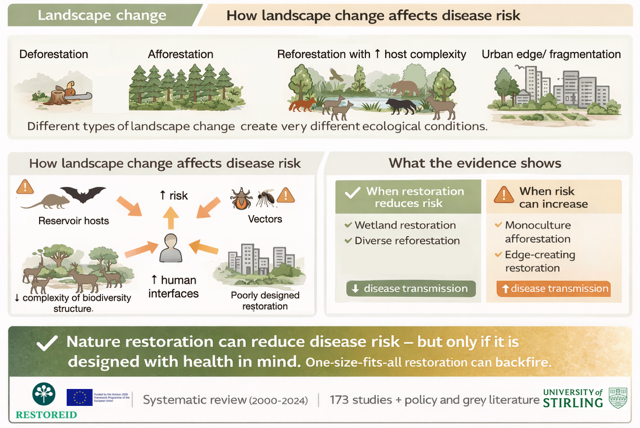
For RESTOREID, this brief represents an important step in translating project findings into practical policy guidance. The project's research has supported that restoration can generate significant benefits for biodiversity and health, but that outcomes depend on ecological context, land-use patterns, species interactions, and how restoration is designed and implemented, supporting the brief's recommendation for a safe-by-design approach to restoration planning.
According to Rainer Sodtke, Biodiversa+ Co-chair:
“The science of nature restoration has never been more well-established or actionable. These briefs take the European research, policy recommendations and practical experience developed in recent years and turn them into guidance that policymakers can use. With the Nature Restoration Regulation now entering its critical phase, Member States have access to practical, evidence-based guidance on creating effective plans. We urge them to use it.”
Biodiversa+ and its network of 81 partner organisations across 39 countries are calling on Member States and their national implementation authorities to use the briefs as a practical guide for reviewing and strengthening their National Restoration Plans.
The current window for action is particularly important. Draft National Restoration Plans are due by 1 September 2026, final plans are expected to be adopted in 2027, and the first revision will not take place until 2032. Decisions made now will therefore influence nature restoration across Europe for years to come.
Explore the policy briefs
📄 Read “Reducing zoonotic risk through nature restoration
🌿 Explore the complete Biodiversa+ restoration policy brief series
Join the webinar
The recommendations on nature restoration and zoonotic risk will be presented and discussed during an online webinar planned for:
14 September 2026 at 14:00 CET
RESTOREID contributors are expected to participate in the discussion.
Registration: To be announced (this article will be updated once the registration link is relased)